
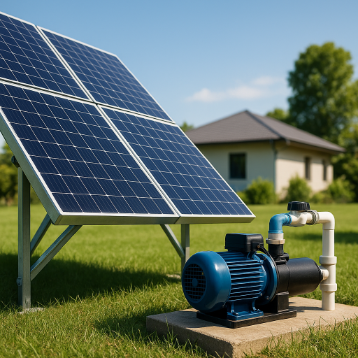
Water problems rarely arrive as minor inconveniences. They show up as weak shower pressure, a basement that floods after heavy rain, a garden that cannot be irrigated properly, or a property that depends on stored or underground water when mains supply is inconsistent. The best water pump solution is not simply the biggest unit available. It is the one matched to how a property uses water, how far the water must travel, what pressure is needed, and how reliably the system must perform day after day. If solar panel installation is part of a broader plan for resilience and lower running costs, that should influence the pump decision early rather than later.
Start with the real water demand of the property
Before comparing models, it helps to define the exact job the pump needs to do. A pump that works beautifully for a small townhouse may be completely unsuitable for a multi-bathroom family home, a guesthouse, or a smallholding with irrigation demands. The source of water matters just as much as the destination. Pumping from a municipal backup tank, drawing from a borehole, moving greywater, and clearing floodwater are all different tasks that call for different designs.
At a practical level, owners should look at four core factors: flow rate, pressure, lift, and duty cycle. Flow rate tells you how much water must move in a given time. Pressure determines whether taps, showers, sprinklers, or appliances will perform properly. Lift refers to the vertical and horizontal distance the pump must overcome. Duty cycle indicates how often the pump is expected to run and whether it can handle prolonged use without strain. Ignoring any one of these can leave you with a system that is noisy, inefficient, or frustratingly unreliable.
- For indoor supply: focus on stable pressure, quiet operation, and automatic switching.
- For irrigation: prioritize flow rate, durability, and compatibility with timers or zones.
- For boreholes or wells: look for depth capability, sand tolerance, and long-run efficiency.
- For drainage: choose rapid water removal, solids handling where needed, and dependable float controls.
Choose the pump type before choosing the brand or size
Different pump types solve different problems, and selecting the correct category is often more important than comparing premium features. In most properties, the decision comes down to whether the job is pressure boosting, water extraction, irrigation supply, or emergency drainage.
| Pump type | Best for | Main strengths | What to watch |
|---|---|---|---|
| Booster pump | Homes with weak mains pressure or tank-fed supply | Improves tap and shower performance, supports appliances, often compact | Must be sized correctly to avoid pressure fluctuations and excessive noise |
| Submersible pump | Boreholes, wells, deep tanks | Efficient at depth, quiet in operation, strong delivery over distance | Installation access and servicing can be more involved |
| Jet pump | Shallow water sources and light domestic use | Common, versatile, easier access for maintenance | Usually less efficient than submersible options for deeper sources |
| Centrifugal pump | Irrigation, transfer between tanks, general circulation | Good flow, straightforward design, suitable for many transfer tasks | Not ideal where high suction lift is required |
| Sump or drainage pump | Basements, stormwater pits, flood-prone areas | Fast water removal, automatic operation available | Needs correct solids handling and proper discharge planning |
A domestic pressure problem, for example, is rarely solved well by a pump designed mainly for moving large volumes of water at low pressure. Likewise, a drainage pump is not a substitute for a pressure-boosting system. The more clearly the role is defined, the easier it becomes to avoid overspending on the wrong equipment.
The best water pump solutions for different property types
A small urban home typically benefits from a compact booster system connected to a storage tank or incoming supply. In this setting, the priorities are quiet operation, consistent pressure, and automatic control. The aim is comfort rather than heavy-duty throughput. Pumps with integrated controllers can work well here because they reduce pressure drops and start only when water is needed.
Larger family homes usually need more than a basic pressure fix. Multiple bathrooms, outdoor taps, washing machines, and irrigation zones can all operate within the same period, creating sudden spikes in demand. In these cases, a higher-capacity booster pump or a pressure system with an adequately sized pressure vessel often makes more sense. That combination helps smooth operation and reduces the rapid cycling that shortens pump life.
For rural properties, farms, and homes that depend on boreholes, a submersible pump is often the strongest long-term answer. It can deliver water from depth more efficiently than many surface options, especially when the system has been designed around the actual drawdown level and expected daily use. Where water is supplied to both the house and the land, it is worth separating domestic pressure needs from irrigation requirements rather than forcing one pump to do everything. That usually results in better control, lower wear, and easier maintenance.
Flood-prone properties need a different mindset altogether. Here, the pump is less about comfort and more about protection. A properly installed drainage or sump pump with dependable level control can prevent costly structural damage. The most useful setup is one that activates automatically, discharges water safely away from the building, and is tested regularly rather than forgotten until the next storm arrives.
- Townhouse or apartment block: compact booster systems and pressure management.
- Family home: pressure pump with balanced output for simultaneous use points.
- Rural home or smallholding: submersible borehole pump with storage and distribution planning.
- Flood-risk property: sump or drainage pump with automatic activation.
Energy planning, pressure control, and solar panel installation
Running costs matter, especially for pumps expected to operate daily or for long periods. A cheap pump with poor efficiency can become expensive over time, while an oversized unit may consume more power than the property actually needs. Good pump selection is therefore not only about hydraulic performance but also about energy discipline. Efficient motors, well-matched controls, and sensible system sizing often have a bigger effect on monthly costs than buyers expect.
This is also where future planning becomes valuable. For owners who want backup independence or lower grid reliance, it is wise to choose a pump system that can integrate smoothly with solar panel installation rather than forcing a redesign later. That does not mean every property needs a solar-driven pump from day one. It means checking startup loads, controller compatibility, storage strategy, and when the pump is most likely to run. A system designed with those realities in mind is easier to operate and simpler to upgrade.
Pressure control deserves equal attention. Excessive pressure can be as problematic as insufficient pressure, placing strain on fittings, valves, and appliances. The most successful systems deliver steady, usable pressure rather than dramatic peaks. In practical terms, that often means pairing the pump with the right controller, pressure vessel, and pipe sizing instead of treating the pump as a standalone purchase.
Installation quality and maintenance determine long-term value
Even an excellent pump can disappoint if the installation is careless. Pipe diameter, suction conditions, air leaks, electrical protection, non-return valves, and mounting all affect performance. Poor suction layout can cause cavitation. Inadequate protection can shorten motor life. Incorrect discharge routing can undermine drainage systems. Professional installation becomes especially important where a pump must serve the whole home, work from a deep source, or operate automatically.
Maintenance, however, is what preserves the investment. Many pump failures begin as small issues: a clogged filter, a damaged seal, a pressure switch out of calibration, or a tank that has lost pressure. A simple inspection routine can prevent much larger repairs.
- Check for unusual noise, vibration, or short cycling.
- Inspect filters, strainers, and intake points regularly.
- Test automatic controls and float switches before heavy-use seasons.
- Look for leaks around fittings, valves, and pressure tanks.
- Review power supply protection and restart behavior after outages.
The best water pump solution is always the one that fits the property rather than the brochure. A small home, a large residence, a borehole-fed plot, and a flood-prone building all ask for different strengths. When the pump is matched to real demand, installed properly, and maintained with care, it delivers more than water: it delivers consistency, protection, and peace of mind. And if future solar panel installation is on the horizon, choosing with that in mind now will make the entire system more practical, efficient, and resilient in the years ahead.
Find out more at
The Water Solar Company | Water Filtration, Pumps & Solar in South Africa
https://www.thewatersolarcompany.co.za/
+27653215803
Cape Town , Western Cape, South Africa
The Water Solar Company is a Cape Town–based specialist in water filtration, pump systems, and solar-powered water solutions for homes, businesses, and agricultural applications across the Western Cape. We design and install reliable water backup systems, solar pumping solutions, and advanced filtration systems that improve water quality, reduce energy costs, and increase water security. Our solutions are tailored to South African conditions, combining sustainable technology with practical engineering expertise. From consultation and system design to installation and maintenance, we provide dependable, energy-efficient water solutions backed by professional service and industry experience.
